
CrowdStrike says its deals average 4x larger when bought through AWS Marketplace, yet in October 2023 the same company said about 2.4x, and it has never published what "larger" is measured against.
That puzzle sits inside a bigger shift: software is increasingly bought where the buyer already has an account, in the cloud bill they already pay or the platform they already work in. I checked how much of the evidence holds up. The channel is real, the "Nx larger" claims are company reports rather than industry facts, and the only number you should trust is your own.
Abstract
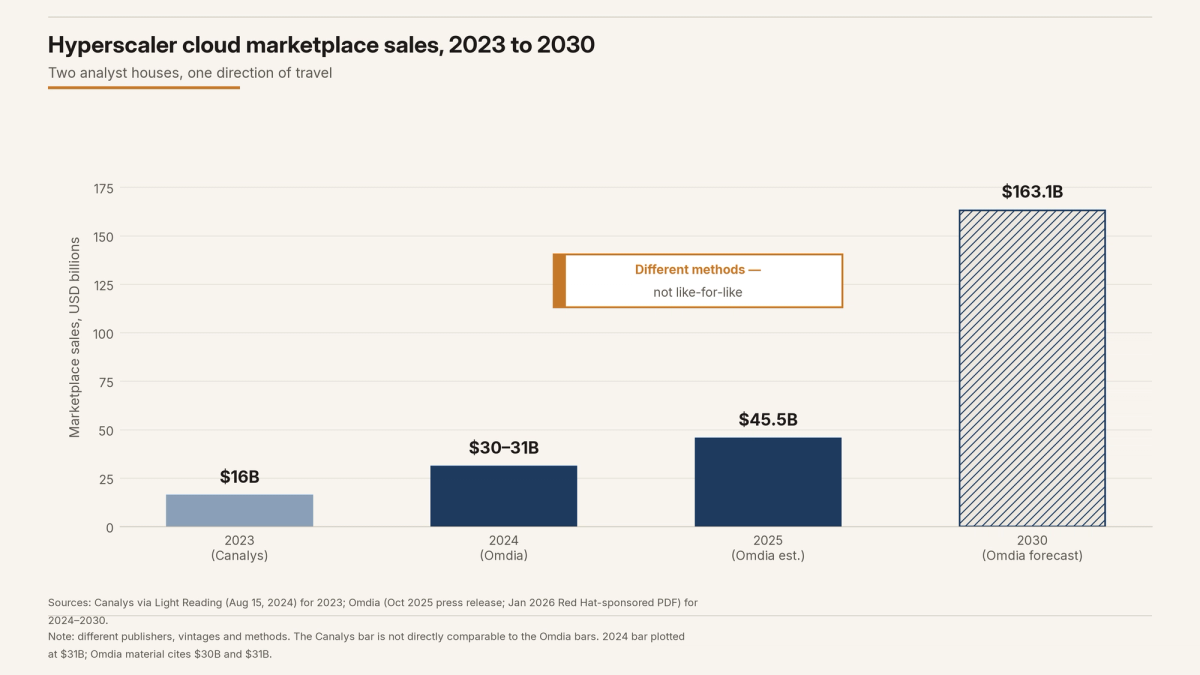
Enterprise software is increasingly bought in two places that are not the vendor's own website or sales team: inside the cloud account the buyer already pays for, and inside the app store of the platform the buyer already works in. I reviewed public evidence for both channels, from press releases, analyst reports, sponsored studies and vendor surveys, and graded each number by who published it and who paid for it. Three findings stand out. First, the scale is real but early: analysts estimate hyperscaler marketplace sales at $16B in 2023 (Canalys) and $45.5B in 2025 (Omdia), with Omdia forecasting $163.1B by 2030, while Canalys noted marketplaces were under 5% of the global software and cybersecurity market [12][13][15][16]. Second, the "larger deals" claim is common but weakly evidenced: reported multiples range from 1.8x to 5x, every one comes from a vendor, a vendor testimonial or an AWS-commissioned study, and none publishes its baseline [1][8][9][10]. Third, platform app stores show very high penetration (91% of Salesforce customers, 95% of HubSpot customers) but a different economic profile, including fee increases in some programs [21][23][27].
The takeaway: software is increasingly bought where the buyer already has an account or already looks. Marketplace "Nx larger" claims are real as company reports but are not industry facts, so measure your own baseline.
Keywords: cloud marketplaces, app stores, committed spend, channel partners, B2B SaaS distribution, procurement.
1. Introduction: the buying shift
Traditional go-to-market assumes a buyer discovers a vendor, a salesperson runs a process, and procurement negotiates paper. Two newer paths remove steps. In the first, the buyer purchases through a hyperscaler marketplace (AWS, Google Cloud, Azure) using an account and payment relationship that already exist. In the second, the buyer finds and installs software inside a platform they already use, such as Salesforce, HubSpot, Atlassian or Shopify. I call the first a payment rail and the second a discovery rail.
I come to this from the second rail. I worked on the AppExchange side of Salesforce, and I now co-found Appnigma, which helps B2B SaaS companies build native CRM integrations and listings. That is a bias, and I flag where it could matter.
Canalys estimated cross-hyperscaler marketplace sales at $16B in 2023 [15]. Omdia estimates $45.5B for 2025 and forecasts $163.1B in 2030, a 29.1% compound annual growth rate [12][13], or a 3.6x increase (our calculation: 163.1 / 45.5). Canalys and Omdia use different methods, so Figure 1's first bar is not a continuation of the others. Scale also needs a denominator: Canalys said marketplaces were "less than 5% of the total global software and cybersecurity market" in August 2023 [16]. The share is probably higher now, but I found no current figure. The channel is growing fast and is still a minority of software spend.
2. Mechanism: committed spend and removed friction
The strongest public explanation for why buyers use cloud marketplaces is financial. Large enterprises sign multi-year spending commitments with cloud providers. Omdia estimates roughly $470B was committed to hyperscalers as of October 2025 [14]. Marketplace purchases can count toward some of it: per Omdia's footnote, up to 25% of the purchase on AWS and Google Cloud and up to 100% of eligible spend on Azure [14]. Microsoft confirms the Azure mechanism but requires the offer to be enrolled as eligible and meet Azure IP co-sell requirements [20]. A software purchase can therefore be funded from budget already agreed. In a survey of more than 100 B2B SaaS vendors, 53% named committed spend drawdown as the single biggest marketplace benefit [11]. Tackle sells marketplace software, so I treat the survey as informative but interested.
The second mechanism is paperwork. CrowdStrike's chief business officer, Daniel Bernard, told CRN in October 2023: "It moves faster, because all the legal work is done, for the most part. You don't need to add a new vendor because AWS is already their vendor. Payment terms are already done. And then because of the AWS credits, that enables these deals to be bigger. So customers can buy more" [3].
This says friction is lower and the funding source is different. It does not say the software is better. Whether deals are actually bigger is empirical, and there the evidence is thinner than the marketing.
3. Evidence from cloud marketplaces
3.1 The CrowdStrike question
The question that started this paper: is there public information that CrowdStrike's deals through AWS Marketplace are four times larger on average? Yes, in one place, and it comes from CrowdStrike itself. On February 26, 2025, CrowdStrike published a press release headlined "CrowdStrike is the First Cloud-Native Cybersecurity ISV to Exceed $1 Billion in Annual AWS Marketplace Sales." The subhead reads: "CrowdStrike's sales deals average 4x larger when transacted in AWS Marketplace." The release also says marketplace sales exceeded $1B in calendar year 2024, with 91% global year-over-year growth [1].
Three qualifications matter before anyone repeats this as a fact about the industry.
- It is company-reported and unaudited. CrowdStrike reports it. No third party verified it.
- The baseline is not defined. "4x larger" than what? All non-marketplace deals, direct deals only, or deals in the same customer segment? The release does not say.
- The claim moved. In October 2023, CrowdStrike said AWS Marketplace transactions were more than 140% larger than in its other channels [2], about 2.4x (our arithmetic). Bernard told CRN the same month that "the deals that go through AWS Marketplace are 145 percent bigger," about 2.45x [3]. The headline moved from roughly 2.4x to 4x in about 16 months.
I do not know why the figure changed, and CrowdStrike has not said. Candidate explanations include a different baseline, a shift in customer and product mix, or bundling under its Falcon Flex licensing model. Constellation Research quotes the CEO describing one customer whose spend grew from $2.2M to more than $5M in annual recurring revenue through Falcon Flex and AWS Marketplace [4], an anecdote I have not checked against the earnings call transcript. These are hypotheses, not findings.
My conclusion: the claim is real and citable, but it is a company marketing statement with no denominator. It should be written as "CrowdStrike reports," never as an industry average.
3.2 Other deal-size claims
Figure 2 collects every deal-size multiple I could verify, labeled by who said it and who paid for it.
- Forrester TEI for ISVs (2022), commissioned by AWS: 80% larger deals (1.8x), a sales cycle shortened from 5 months to 3, and 27% more deals closed. It is a composite from 12 interviews and a 60-respondent survey; the composite ISV returned a three-year NPV of $646K and an ROI of 81% [9].
- Forrester TEI for channel partners (2023), commissioned by AWS: deal sizes 4x to 5x richer through private offers, up to 50% faster closes and 234% ROI, based on 27 individuals at 14 partners [10].
- AppDynamics: an undated testimonial on AWS's partner page cites "5X higher average subscription price (ASP) for deals transacted in AWS Marketplace, when compared to ASPs for our direct deals" [8].
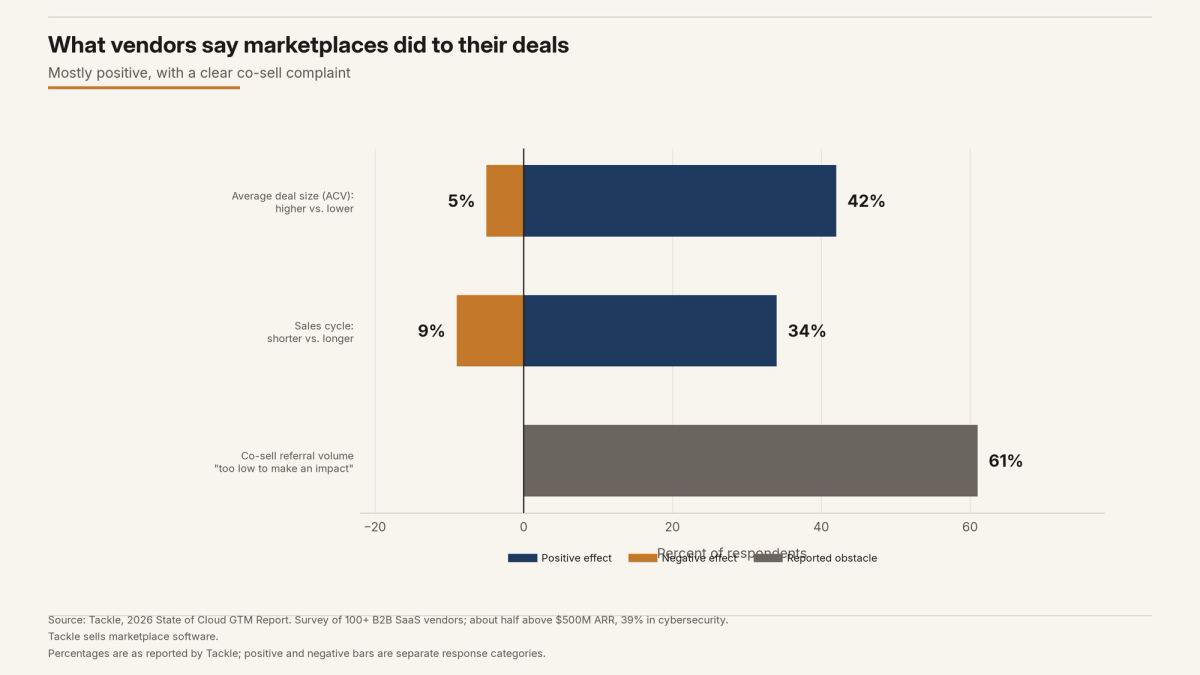
- Tackle's 2026 survey: 42% of respondents reported higher ACV through marketplace sales and 5% lower [11].
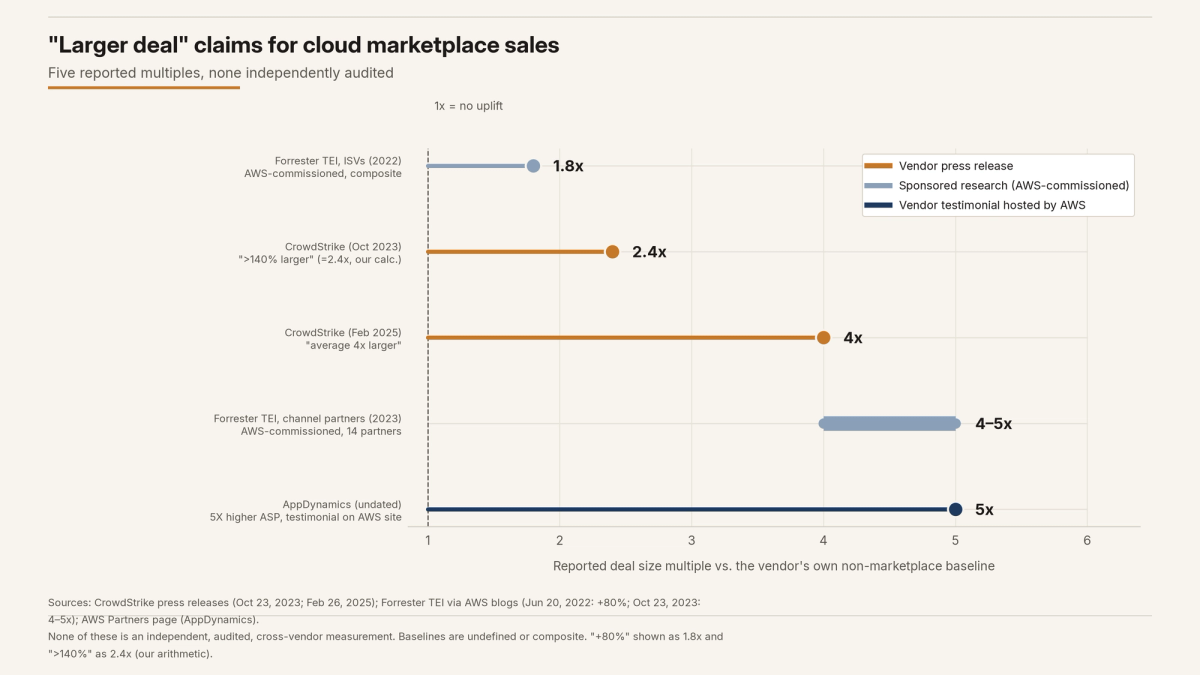
Reported uplifts run from 1.8x to 5x, and every number comes from a vendor, a testimonial hosted by AWS, or a study AWS commissioned. I found no independent, audited, cross-vendor study measuring a deal-size uplift with a defined baseline. That is the most important gap in the evidence.
3.3 Milestones from large sellers
Dollar milestones show that money moves through the channel, not that deals are bigger, and they use different units. CrowdStrike reports more than $1B in calendar-2024 AWS Marketplace sales [1] and Snowflake more than $2B in calendar 2025 [5]. Okta reports $1B aggregate total contract value over four years [6] and Wiz more than $1B lifetime [7], both cumulative, so I have not put them on one chart.
I excluded three figures repeated in newsletters and social posts because none had a primary source: a "$2B+" AWS Marketplace figure attributed to Datadog (Datadog's own December 2025 release names the marketplace but gives no dollar amount), an Okta annual figure of roughly $750M, and a CrowdStrike $1.5B total contract value figure.
4. The channel turns partner-led
Omdia's data shows channel partners and distributors accounting for 27% of hyperscaler marketplace spend in 2024, 36% in 2025 and 59% by 2030 [14].
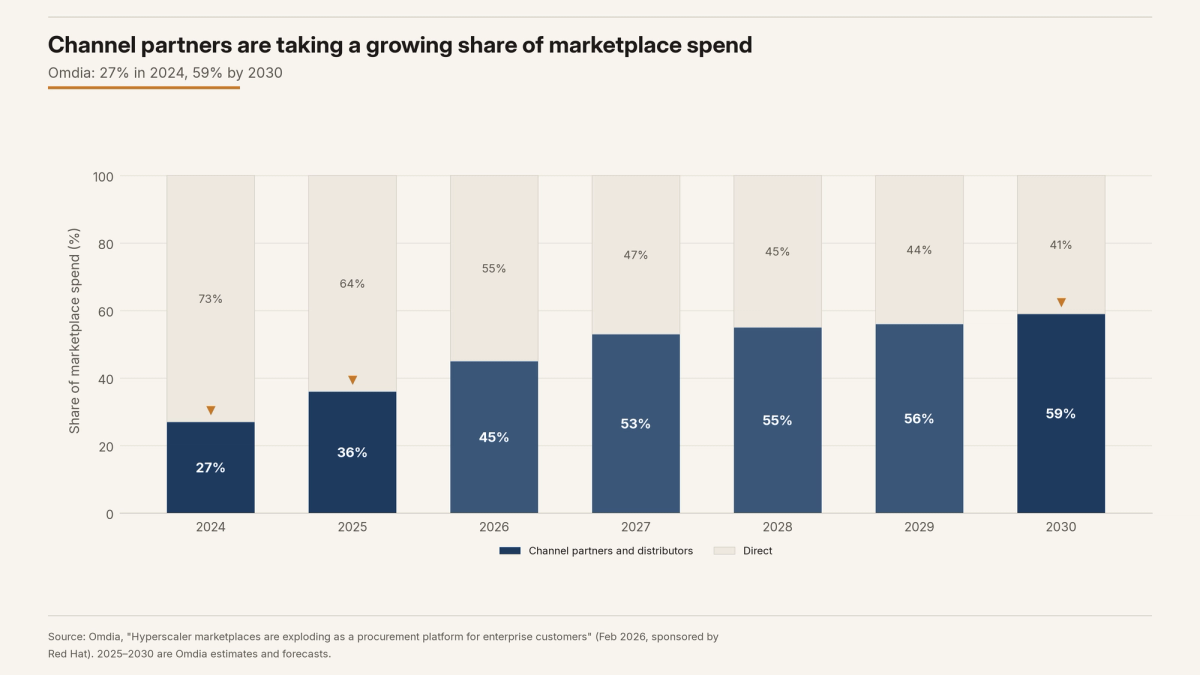
Private offers let resellers and integrators stay in the deal. Google reported that third-party gross transaction value resold through channel partners grew 170% from 2023 to 2024 [19].
This matters for deal size: if resellers and integrators are transacting, "marketplace deal size" measures a mixed population of buyers, partners and bundles.
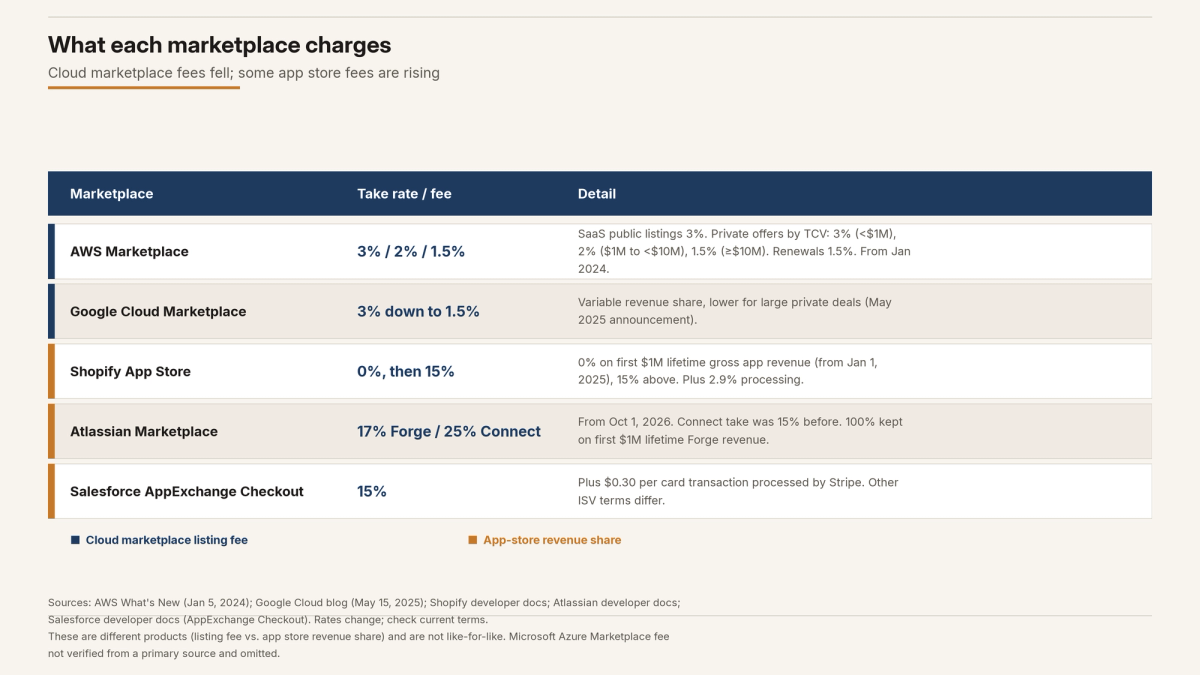
Fees have also fallen. In January 2024 AWS cut listing fees to 3% for public SaaS listings, and for private offers to 3% under $1M in total contract value, 2% from $1M to under $10M and 1.5% above $10M, with renewals at 1.5% [18]. Google Cloud's revenue share runs from 3% down to 1.5% for large private deals [19]. Figure 5 puts these alongside app store fees.
5. Platform app stores: where customers already look
Cloud marketplaces are a payment rail. App stores are a discovery rail: the buyer is already inside the platform, and the listing sits where they look for the next tool.
- Salesforce AppExchange. In February 2026 Salesforce reported more than 9,000 listings from more than 9,600 partners, more than 14 million installs, and that 91% of customers use at least one partner app [21]. AppExchange Checkout charges 15% plus $0.30 per card transaction processed by Stripe [22].
- HubSpot Marketplace. More than 2,000 apps, more than 288,000 customers, 95% of customers with at least one app, and an average of more than nine apps per customer. Listing is free [23].
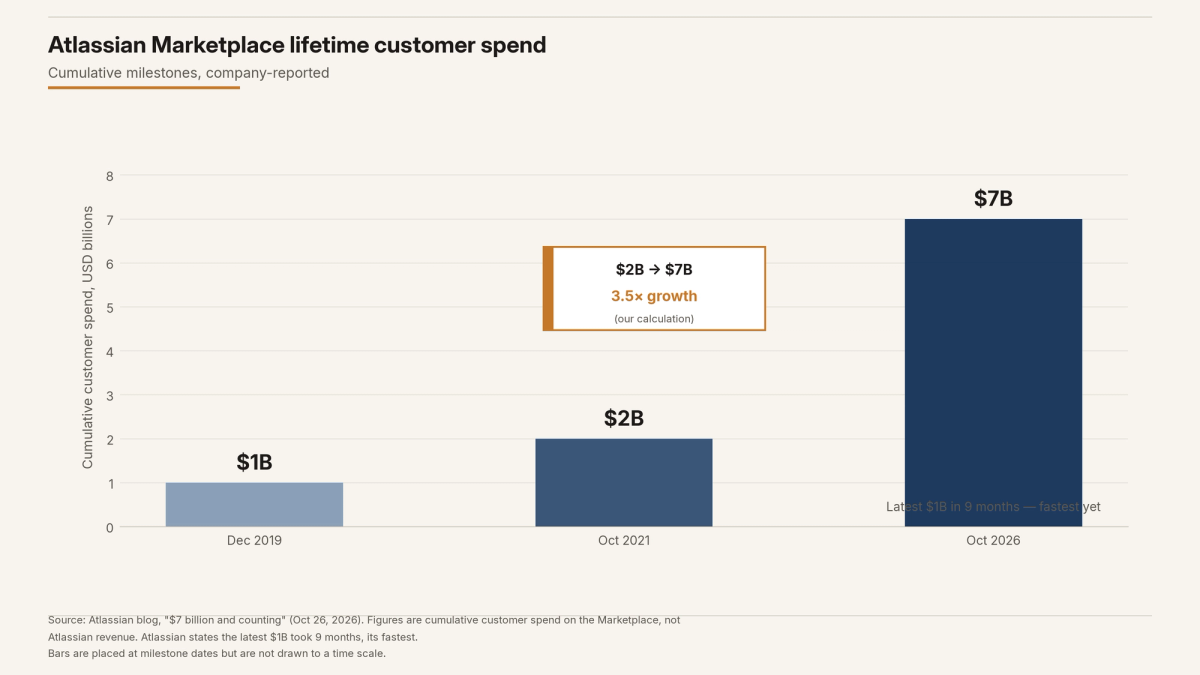
- Atlassian Marketplace. On October 26, 2026 Atlassian reported $7B in lifetime customer spend, the latest $1B arriving in 9 months, its fastest yet, after $1B in December 2019 and $2B in October 2021 [26]. From $2B to $7B is 3.5x in five years (our calculation). Penetration is lower: more than 40% of customers have at least one app [26]. The $7B is customer spend, not revenue.
- Shopify App Store. Shopify reported paying more than $1.3B to developers in 2025, with more than 21,000 apps listed and active installs up roughly 20% year over year [24]. Developer terms charge 0% on the first $1M of lifetime gross app revenue and 15% above that [25].
- Browser extensions and consumer stores. Google launched a curated, admin-approved Chrome Web Store for enterprises in January 2025 [29]; I found no primary-source extension counts. As analogy only, an Apple-funded study estimates about $1.3T in billings and sales facilitated through its App Store ecosystem in 2024 [28]; "facilitated" is broad.
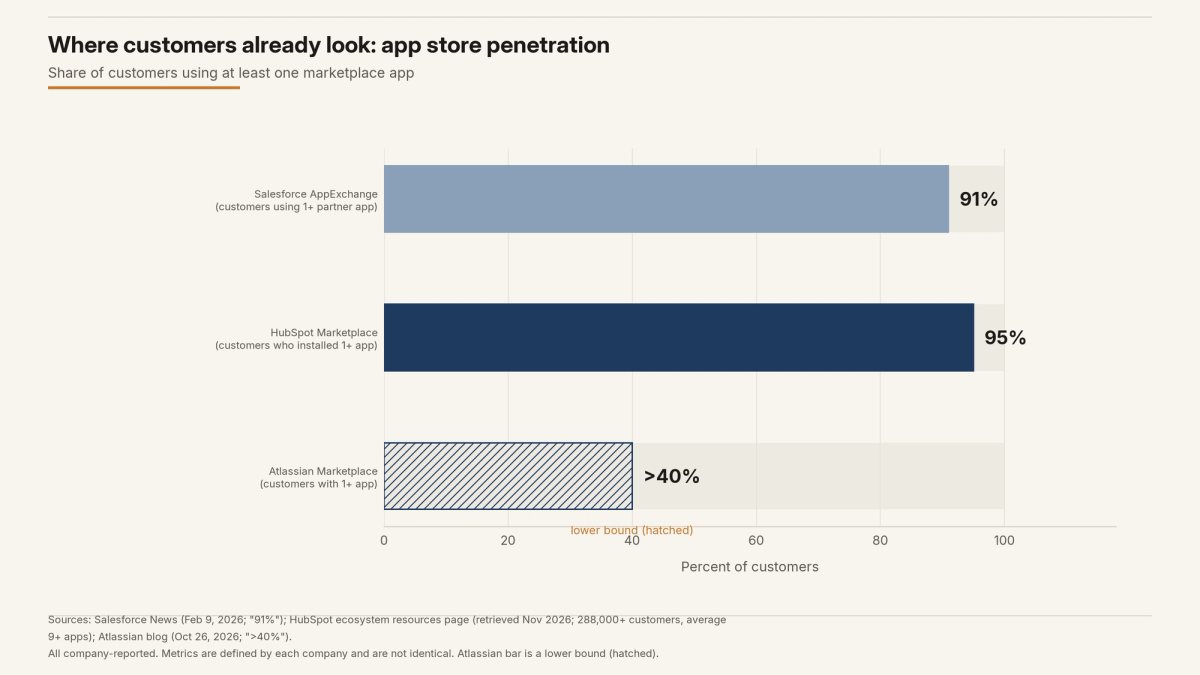
Fig 4. Share of customers using at least one marketplace app. Sources: Salesforce, HubSpot, Atlassian. Company-reported, defined by each company; Atlassian is a lower bound.
Penetration is highest where the app store is native to the system of record, as you would expect if buyers look there first. I found no revenue or deal-size figures for several large stores and no primary data on vertical industry marketplaces, so I make no claim about them. "Where customers already look" is better evidenced than "what they spend when they find you."
6. Economics and counterpoints
A paper that only reports the good news is marketing. These are the limits, in rough order of importance.
Company-reported and promotional. Nearly every dollar milestone above is a vendor or AWS press release. CrowdStrike's 4x has no denominator, and its own earlier figure was lower [1][2].
Sponsor bias. AWS commissioned both Forrester studies, which use composite models [9][10]. Red Hat sponsored the Omdia material [13][14]. Tackle sells marketplace software [11]. Apple funded its own study [28]. Sponsored work can be rigorous, but I weight it accordingly.
Selection effects. Vendors most likely to publish a milestone are those for whom it worked, and customers most likely to buy through a marketplace are large ones with large cloud commitments. Bigger deals might reflect bigger customers, not a better channel, and without a baseline matched on customer size "4x larger" cannot separate the two. Tackle's respondents skew large (about half above $500M ARR, 39% in cybersecurity), and the heaviest marketplace sellers are described as the least convinced of their value [11].
Co-sell friction. In the survey, 71% of vendors say cloud-provider requirements have risen, 75% say requirements are outpacing support, and 61% say co-sell referral volume is too low to make an impact [11].
The drawdown cap and commit cycle. A 25% cap on AWS and Google means a purchase cannot absorb a whole commitment [14]. Canalys argued in 2023 that hyperscalers would eventually have to "wean customers off the drug of committed cloud spend," because customers had over-committed [16]. If commitments shrink, the main financial incentive weakens.
Fee creep. Cloud marketplace fees have fallen, but app stores point the other way in places. Atlassian's revenue share, effective October 1, 2026, has Atlassian keeping 17% on Forge apps and 25% on Connect apps, up from 15% on Connect [27]. Shopify's 15% applies above the first $1M of lifetime revenue [25].
Share and forecast risk. Lifetime, aggregate-TCV, calendar-year and "facilitated" figures are different measures, so be wary of any chart that mixes them. Marketplaces were under 5% of software and cybersecurity spend when Canalys last gave a share [16].
7. Implications for B2B SaaS
This sequencing framework is a judgment, not a result, and companies need not climb it in order.
Step one: be where the buyer already works. If your product touches a CRM, a native listing puts you where a very high share of customers already look: 91% of Salesforce customers use at least one partner app and 95% of HubSpot customers have installed at least one [21][23]. This is a discovery rail and needs no cloud commitment.
Step two: list on a cloud marketplace where commit-funded deals exist. If you sell to large enterprises with hyperscaler commitments, a listing can let a buyer use budget already approved [14].
Step three: work through channel partners with private offers. If Omdia is right that partners will handle most marketplace spend by 2030, channel private offers become the main path for many deals [14].
What to measure yourself. Do not borrow anyone's multiple. Measure on your own data: (1) marketplace deal size versus a defined baseline, matched on customer size and product mix; (2) sales cycle length per channel; (3) referral volume from the marketplace operator and its conversion; (4) fees and incentives paid, net of credits; (5) renewal and expansion, to separate a one-time bump from durable value.
A note on Appnigma. The same reasoning applies one layer down: the buyer is already in their CRM, and its app store is the first marketplace many B2B SaaS companies can join. I cite no Appnigma performance numbers because I have no public, defensible dataset.
Conclusion
Software is increasingly bought through accounts the buyer already pays for and in places the buyer already looks, and the scale is large and growing quickly. The stronger claim, that marketplace deals are reliably several times larger, is not supported by independent evidence. CrowdStrike's 4x is real as a company report, and so are the others, but they are vendor and sponsor claims with undefined baselines and likely selection effects. They are not industry facts.
The better question for any B2B founder is not "should I list on a marketplace," but "where does my buyer already have an account, and what would it cost me to be there?" Answer it with your own baseline.
About the author
Sunny Chauhan is the co-founder and CEO of Appnigma AI, which builds and maintains customer integrations and native Salesforce and HubSpot apps for B2B SaaS teams. Before Appnigma, he was on Salesforce's AppExchange team, where he worked with more than 300 SaaS partners. He has spent close to a decade on the Salesforce platform, including work at Zennify, and holds Salesforce certifications including Platform Developer II, Platform App Builder, Administrator, Data Cloud Consultant, and AI Associate.
Appendix A. Methods and limitations
Approach. I used primary documents where possible, then analyst reports, then sponsored studies and vendor surveys. News coverage was used only to locate primary sources or relay quotes. I excluded anything I could not trace to a source I had opened.
Labels. Primary sources are self-reported. Analyst: Canalys, Omdia. Sponsored: the AWS-commissioned Forrester studies, Red Hat-sponsored Omdia material, Tackle, Apple. Secondary: Light Reading, CRN, Constellation Research.
Arithmetic. Derived numbers are labeled "our calculation": 2.4x from ">140% larger," 1.8x from "+80%," 3.6x from $45.5B to $163.1B, and 3.5x from $2B to $7B.
Limitations.
- Some pages could not be fetched directly (the Omdia press release, CrowdStrike's 2023 investor page); I corroborated through other sources.
- The CrowdStrike customer anecdote comes via Constellation Research, not the earnings call transcript.
- Microsoft's marketplace fee was not verified and is omitted.
- Slack and Zoom marketplace revenue, Chrome extension counts and vertical industry marketplaces lacked primary data.
- I found no independent, non-sponsored study measuring a marketplace deal-size uplift with a defined baseline.
- Excluded for low confidence: Datadog "$2B+," Okta "~$750M a year," CrowdStrike "~$1.5B TCV."
Appendix B. Claim ledger (abridged)
| Claim | Value | Source | Date | Label |
|---|---|---|---|---|
| CrowdStrike deal size via AWS Marketplace | 4x, baseline undefined | CrowdStrike [1] | Feb 26, 2025 | Company-reported |
| CrowdStrike AWS Marketplace sales, 2024 | more than $1B, up 91% | CrowdStrike [1] | Feb 26, 2025 | Company-reported |
| CrowdStrike earlier claim | more than 140% larger (about 2.4x) | CrowdStrike [2] | Oct 23, 2023 | Company-reported |
| CrowdStrike CBO to CRN | "145 percent bigger" (about 2.45x) | CRN [3] | Oct 2023 | Interview quote |
| Snowflake AWS Marketplace sales | more than $2B, calendar 2025 | AWS [5] | Dec 3, 2025 | Company-reported |
| Okta AWS Marketplace | $1B aggregate TCV, four years | Okta [6] | Mar 3, 2025 | Company-reported, cumulative |
| ISV deal size | 80% larger (1.8x); cycle 5 to 3 months | Forrester for AWS [9] | Jun 20, 2022 | Sponsored |
| Channel partner deal size | 4x to 5x; 234% ROI | Forrester for AWS [10] | Oct 23, 2023 | Sponsored |
| AppDynamics subscription price | 5X vs direct | AWS Partners page [8] | Undated | Testimonial |
| Higher vs lower ACV via marketplace | 42% vs 5% | Tackle [11] | 2026 | Vendor survey |
| Market size | $16B (2023); $45.5B (2025); $163.1B (2030) | Canalys [15]; Omdia [12][13] | 2024 to 2026 | Analyst |
| Channel share of marketplace spend | 27% (2024), 36% (2025), 59% (2030) | Omdia [14] | Feb 2026 | Analyst, sponsored |
| AWS marketplace fees | 3% / 2% / 1.5% by deal size | AWS [18] | Jan 5, 2024 | Primary |
| AppExchange penetration | 91% of customers; 14M+ installs | Salesforce [21] | Feb 9, 2026 | Company-reported |
| Atlassian Marketplace | $7B lifetime customer spend; 40%+ penetration | Atlassian [26] | Oct 26, 2026 | Company-reported |
| Shopify developer payouts | more than $1.3B in 2025 | Shopify [24] | Apr 28, 2026 | Company-reported |
References
[1] P. CrowdStrike, "CrowdStrike is the First Cloud-Native Cybersecurity ISV to Exceed $1 Billion in Annual AWS Marketplace Sales," Feb 26, 2025. https://www.crowdstrike.com/en-us/press-releases/crowdstrike-first-cloud-native-cybersecurity-ISV-surpass-one-billion-aws/
[2] P. CrowdStrike, first cybersecurity ISV founded in the cloud to exceed $1B cumulative AWS Marketplace sales, Oct 23, 2023. https://ir.crowdstrike.com/news-releases/news-release-details/crowdstrike-first-cybersecurity-isv-founded-cloud-exceed-1 (page blocked to scripted fetch; text read via search results and CRN)
[3] X. CRN, "CrowdStrike CBO Daniel Bernard On Surging AWS Marketplace Growth With Partners," Oct 2023. https://www.crn.com/news/security/crowdstrike-cbo-daniel-bernard-on-surging-aws-marketplace-growth-with-partners
[4] X. Constellation Research, "Big software deals closing on AWS Marketplace, rival efforts," Sep 2, 2024 (quotes Salesforce and CrowdStrike earnings calls). https://www.constellationr.com/insights/news/big-software-deals-closing-aws-marketplace-rival-efforts
[5] P. AWS Press Center, "Snowflake doubles AWS Marketplace growth YoY, eclipses $2 billion in sales," Dec 3, 2025. https://press.aboutamazon.com/aws/2025/12/snowflake-doubles-aws-marketplace-growth-yoy-eclipses-2-billion-in-sales-as-new-integrations-accelerate-enterprise-data-and-ai-adoption
[6] P. Okta, "Okta passes $1 billion in sales in AWS Marketplace," Mar 3, 2025. https://www.okta.com/newsroom/press-releases/okta-passes-1-billion-in-sales-in-aws-marketplace/
[7] P. Wiz, "$1 billion in AWS Marketplace lifetime sales," Dec 2, 2025. https://www.wiz.io/blog/1-billion-aws-marketplace-lifetime-sales
[8] P (testimonial). AWS Partners, AWS Marketplace page (AppDynamics 5X ASP quote; Forrester channel summary). https://aws.amazon.com/partners/marketplace/
[9] S. Forrester Total Economic Impact for AWS Marketplace sellers (AWS-commissioned), via AWS Marketplace blog, Jun 20, 2022. https://aws.amazon.com/blogs/awsmarketplace/total-economic-impact-partner-opportunity-analysis-aws-marketplace-sellers-forrester/
[10] S. Forrester Total Economic Impact for channel partners selling in AWS Marketplace (AWS-commissioned), via AWS APN blog, Oct 23, 2023. https://aws.amazon.com/blogs/apn/a-total-economic-impact-partner-opportunity-analysis-for-channel-partners-selling-in-aws-marketplace/
[11] S. Tackle, 2026 State of Cloud GTM Report. https://state-of-cloud-gtm-report-2026.tackle.io/
[12] A. Omdia, "Hyperscaler cloud marketplace sales to hit US$163 billion by 2030," Oct 6, 2025. https://omdia.tech.informa.com/pr/2025/oct/hyperscaler-cloud-marketplace-sales-to-hit-us-163-billion-us-dollars-by-2030 (page blocked to scripted fetch; corroborated by [13])
[13] A/S. Omdia, "Hyperscaler marketplaces: a fast-growing model for software procurement," Jan 2026, sponsored by Red Hat. https://www.redhat.com/rhdc/managed-files/cl-omdia-hyperscaler-marketplaces-analyst-material-3529349-202602-en.pdf
[14] A/S. Omdia, "Hyperscaler marketplaces are exploding as a procurement platform for enterprise customers," Feb 2026, sponsored by Red Hat. https://www.redhat.com/rhdc/managed-files/cl-omdia-hyperscalers-procurement-platform-analyst-material-3613126-202602-en.pdf
[15] A. Canalys via Light Reading, "Hyperscaler cloud marketplace sales to hit $85 billion by 2028," Aug 15, 2024. https://www.lightreading.com/cloud/hyperscaler-cloud-marketplace-sales-to-hit-85-billion-by-2028-canalys
[16] A. Canalys, "Hyperscaler cloud marketplaces force greater disruption in SaaS channels," Aug 2023. https://canalys.dev/insights/hyperscale-cloud-marketplaces-saas-channels
[17] A. Canalys, cloud marketplace forecast, Jan 26, 2023. https://canalys.dev/newsroom/cloud-marketplace-forecast-2023
[18] P. AWS What's New, "AWS Marketplace simplified, reduced listing fees," Jan 5, 2024. https://aws.amazon.com/about-aws/whats-new/2024/01/aws-marketplace-simplified-reduced-listing-fees/
[19] P. Google Cloud blog, "Upgrades to Google Cloud Marketplace for partners," May 15, 2025. https://cloud.google.com/blog/topics/partners/upgrades-to-google-cloud-marketplace-for-partners
[20] P. Microsoft Learn, Azure consumption commitment enrollment. https://learn.microsoft.com/en-us/partner-center/marketplace-offers/azure-consumption-commitment-enrollment
[21] P. Salesforce News, IDC MarketScape application platform marketplaces, Feb 9, 2026. https://www.salesforce.com/news/stories/idc-marketscape-application-platform-marketplaces-2025-2026/
[22] P. Salesforce Developer docs, AppExchange Checkout. https://developer.salesforce.com/docs/atlas.en-us.packagingGuide.meta/packagingGuide/appexchange_checkout_overview.htm
[23] P. HubSpot, ecosystem resources (retrieved Nov 2026). https://www.hubspot.com/technology/ecosystem-resources
[24] P. Shopify, "The developers behind Shopify's $1.3 billion app ecosystem," Apr 28, 2026. https://www.shopify.com/news/billion-dollar-ecosystem
[25] P. Shopify developer docs, revenue share. https://shopify.dev/docs/apps/launch/distribution/revenue-share
[26] P. Atlassian blog, "$7 billion and counting," Oct 26, 2026. https://www.atlassian.com/blog/teamwork/atlassian-marketplace-7-billion
[27] P. Atlassian developer docs, pricing, payment and billing. https://developer.atlassian.com/platform/marketplace/pricing-payment-and-billing/
[28] S. Apple Newsroom, "Global App Store helps developers reach new heights," Jun 2025 (Apple-funded study). https://www.apple.com/newsroom/2025/06/global-app-store-helps-developers-reach-new-heights/
[29] P. Google Cloud blog, new Chrome Web Store for enterprises, Jan 23, 2025. https://cloud.google.com/blog/products/chrome-enterprise/boost-productivity-and-security-with-the-new-chrome-web-store-for-enterprises