
From spec to listed managed package. In one sprint, not two quarters.
Apex, LWC, and metadata for a managed package, built to pass Security Review. Listed on the AppExchange in weeks, not months. You get the package, not a project.


Built by ex-Salesforce AppExchange engineers
300+ SaaS partners worked with inside Salesforce's AppExchange team
A Salesforce AppExchange development company builds, packages, and lists a native managed package on Salesforce's marketplace on your behalf. The work covers managed package (2GP) development, Apex and Lightning Web Component engineering, architecture and data model design, security review preparation, and the AppExchange listing itself. Agency engagements for a first app typically run $80K to $300K and take 6 to 12 months.
Appnigma is a done-for-you AppExchange development company founded by a former member of Salesforce's own AppExchange team. We build the package for you at a flat quoted price, you keep the code and the IP, and most customers are listed in about 8 weeks with no Salesforce developer on their team.
Trusted by teams selling into enterprise.


Everything between your product spec and a live marketplace listing.
Managed package development (2GP)
Namespace registration, second-generation packaging, version management, and upgrade paths so customers install and update cleanly. Your namespace is registered to you, so the package stays yours if you ever take it in house.
Apex and LWC engineering
The Apex classes, triggers, LWCs, metadata, and test classes a senior Salesforce engineer writes by hand, structured from the start to clear Security Review. Test coverage is written alongside the code rather than bolted on to satisfy the submission threshold.
Architecture and data model design
Object model, sharing and visibility rules, governor limit planning, and API strategy decided before the first line of code. Getting the data model wrong is the one mistake that cannot be patched later without asking every customer to reinstall.
Native product integration
Real bidirectional sync between your application and your customer's org. A native app inside Salesforce, not an iframe and not middleware. That means no per-record usage fees and no third party sitting in the path of your customers' data.
Security Review preparation
Code Analyzer and PMD scanning, false positive documentation, penetration test coordination, and the submission itself. Our co-founder was on Salesforce's AppExchange team and worked with 300+ SaaS companies going through this review. We answer Salesforce's follow-up questions directly, so your engineers are not pulled back in weeks after they thought the build was done.
Listing and Partner Console setup
Partner Console configuration, listing metadata, screenshots, demo org provisioning, and the business plan steps that gate submission. The paperwork around a listing stops more first-time ISVs than the code does, and none of it is on you.
Post-listing maintenance
Three Salesforce seasonal releases a year can break a package. We handle regression testing and updates so your listing stays live. A listing that breaks after a release is delisted quietly, and the first signal is usually a customer telling you.
ISV consulting and packaging strategy
Licensing model, install limits, Trialforce, and monetization decided alongside the build rather than retrofitted after listing. Licensing decided after launch means a version bump and a migration for everyone already installed.
Fixed scope, quoted upfront. Never hourly.
- 01Week 1
Scoping and requirements
We map what your product needs to read and write in Salesforce and agree a fixed scope. Scope is written down before anything is quoted, so the price does not move once work starts.
- 02Week 1
Architecture and data model
Object model, sharing rules, and API design signed off before build. This is the last stage where a change is cheap, so it is the one we slow down for.
- 03Week 2
Package build
Apex, LWC, metadata, and test classes written to Security Review standards. The part that takes agencies months. It is also the part your own engineers never have to pick up.
- 04Week 2 to 3
Package assembly
Namespace, 2GP packaging, and version setup. The namespace is registered in your name from the start, not ours.
- 05Week 3
Scanning and hardening
Code Analyzer and PMD, every finding fixed or documented as a justified false positive. Findings are resolved before submission rather than after Salesforce sends them back.
- 06Week 4, then queue
Security Review submission
We prepare and submit, then handle Salesforce's questions directly. The queue time is Salesforce's rather than ours, and we tell you where you are in it.
- 07Parallel with review
Listing
Partner Console, listing copy, screenshots, and demo org. Runs alongside the review so the listing is ready the day you pass.
- 08Ongoing
Handover and maintenance
You receive full source and IP. We keep the package current across seasonal releases. The source lands in your repository, with no licence required to keep it running.
The package itself is typically built in about a week. The 8 week figure covers the full path to a live listing, most of which is Salesforce's own Security Review queue rather than engineering time.
"I spent years on Salesforce's AppExchange team, sitting across the table from more than 300 SaaS companies. I watched them fail security review over and over, for the same handful of reasons. So I left to build the thing that stops it."
Most teams fail review because they find out what it actually checks after the app is already built. We start from the review criteria and work backwards. That is the whole difference, and it is why first-try passes are normal for us rather than lucky.
Co-founder and CEO. Salesforce Platform Developer II. Previously Salesforce AppExchange team, and Salesforce Developer at Zennify.
- SaaS partners worked with inside Salesforce
- SaaS partners worked with inside Salesforce
- Combined Salesforce ecosystem experience, Sunny and AJ
- Combined Salesforce ecosystem experience, Sunny and AJ
Sunny Chauhan, Co-founder and CEO
Ex-Salesforce AppExchange team. Salesforce Developer at Zennify. Ran Facebook's DevCircle community in Sacramento. Certified Platform Developer II, Platform App Builder, Administrator, Data Cloud Consultant.
Amarjit "AJ" Singh, Co-founder and CTO
Seven years shipping production software, hands on keyboard. Shipped production Salesforce solutions at Zennify and Banc of California.
Salesforce audits every app before it can be listed. Roughly half of first submissions fail, and a remediation cycle adds six to nine weeks. We design against these criteria from day one rather than discovering them after the build.
- 01
Static code analysis
Code Analyzer and PMD are run across the package. Every finding has to be fixed or documented as a justified false positive, and an undocumented one is enough to send the submission back.
- 02
Penetration testing
Your app is probed as a live system, not read as source. This is where apps that passed their own linting still fail, because the finding is behavioural rather than syntactic.
- 03
How you handle data
Where records go, what leaves the org, and what you store outside it. An app that quietly moves customer data somewhere unexpected does not get listed.
- 04
Sharing and visibility
Whether your package respects the org's own permission model rather than working around it. Sharing is the area org development habits transfer to a package worst.
- 05
The submission itself
The review is a conversation, not a verdict. Salesforce comes back with questions, and someone has to answer them precisely and quickly for the queue to keep moving.
- 06
What a failure costs
A failed first submission is not just a rejection. It is six to nine weeks of billable remediation on an agency engagement, and it lands after you have already told customers a date.
The exact artifacts a senior Salesforce engineer writes by hand, Apex, LWC, metadata, test classes, structured to clear AppExchange Security Review. Built for you, without the years of platform expertise or the six-figure bill.
Pricing this against building a team? See what it costs to hire AppExchange developers.
A 4 to 9 month build becomes a one-week sprint. Same managed package, listed first.
Your code. Your IP. No retainer.
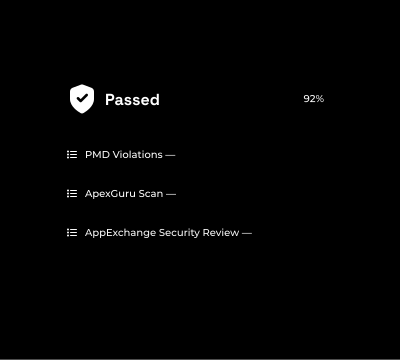
Every check passed before you submit.

Native managed package apps
Listed on the AppExchange under your namespace. Customers install it from the marketplace the same way they install any other app.
Bidirectional integrations
Product-to-Salesforce sync delivered as a native package. Records move both ways on your schema, not through a generic connector.
Lightning Web Components
Embedded directly in your customers' Salesforce UI. Your product appears on the record pages their team already works in.
Flow actions and invocable Apex
So admins can use your product inside their automations. No developer is needed on their side to wire your app into a process.
One layer for Salesforce and HubSpot
Adding the second marketplace does not mean a rebuild. The integration logic is written once and packaged for each platform.
Already have an app?
We take on Security Review remediation and stalled listings as standalone work. Bring the findings you were sent and we work through them with you.
Faster than agencies. More native than middleware. Cheaper than a platform team.
Your code. Your IP. No rent forever.

~8 weeks, not 6 to 12 months. List first.

A real Salesforce app. Not an iframe.
One layer for Salesforce and HubSpot. No rebuild to add the other.

“We had zero Salesforce development experience, but still launched a fully functional managed package within a week. The platform made the process incredibly simple - no code, no waiting on engineers. Total game-changer.”
Maximus Greenwald
CEO, Warmly.ai

Quoted upfront for a fixed scope. We do not bill hourly and we do not charge per seat. You keep the code, so there is no permanent platform rent and no retainer required to keep your app alive. Most teams use this to skip the $150K to $300K ISV agency deal entirely.
Starter
Custom
Your native Salesforce integration.
- Native Salesforce managed package
- Slack support
Professional
Most PopularCustom
Integration, listed on the AppExchange.
- Everything in Starter
- AppExchange listing
- Security Review
- Dedicated Salesforce expert
- Partnership process expedited
Enterprise
Custom
Appnigma AI infrastructure for your enterprise customers.
- Everything in Professional
- Sales Solution Engineer Agent
- Integration Support Agent
- Integration Maintenance Agent
- Integration Enhancement Agent
It builds, packages, and publishes a native app on the Salesforce AppExchange for you. That covers managed package development, Apex and Lightning Web Component engineering, security review preparation, listing setup, and ongoing maintenance across Salesforce's three annual releases.
Agency engagements for a first app commonly run $80K to $300K, with maintenance retainers of $22K to $45K per year after launch. Appnigma quotes a flat price upfront for a fixed scope, with maintenance included and no hourly billing.
A traditional agency build runs 6 to 12 months. With Appnigma the package is typically built in about a week and most customers are live in about 8 weeks. The largest variable is Salesforce's Security Review queue, not engineering time.
Yes. You receive the full source for your managed package and own the IP outright. There is no ongoing license required to keep your app running and no retainer needed to retain access to your own code.
Security Review is Salesforce's mandatory audit before any app can be listed, covering static analysis, penetration testing, and how your app handles data and sharing. We prepare the submission, document false positives, and respond to Salesforce directly. Our co-founder spent years on Salesforce's AppExchange team working with more than 300 SaaS companies through this review, which is why we design against the criteria from day one.
Yes, and most of our customers are in exactly that position. Warmly launched a fully functional managed package within a week with zero prior Salesforce development experience and passed Security Review on the first attempt.
Yes. Packaging strategy, licensing and monetization, install limits, and listing positioning are decided as part of the engagement rather than sold as a separate retainer. If you already have an app and need only Security Review remediation, we take that on its own.
Our own team, not subcontractors. Appnigma was founded by Sunny Chauhan, previously on Salesforce's AppExchange team and a Salesforce Developer at Zennify, and Amarjit Singh, who shipped production Salesforce solutions at Zennify and Banc of California. Between them, 12 years in the Salesforce ecosystem.
Custom development builds functionality inside one customer's org. AppExchange development produces a distributable managed package many customers install, which means namespace and packaging constraints, upgrade paths, and a mandatory Security Review that org work never faces.