

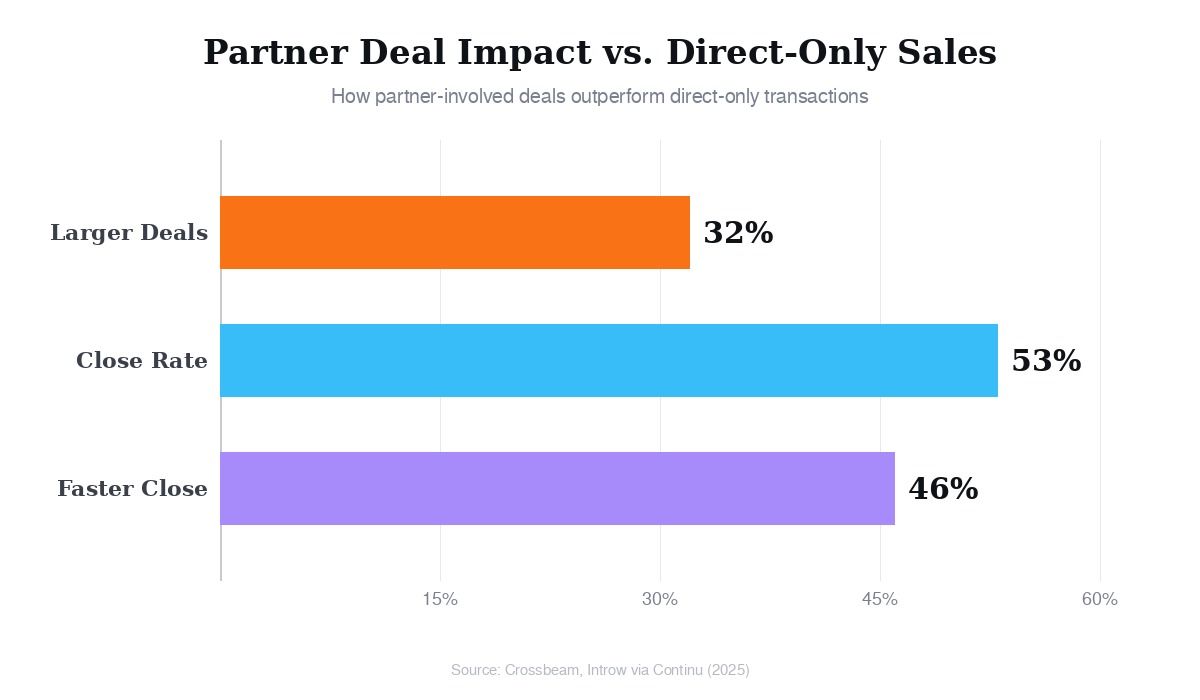
Partner-sourced deals are 53% more likely to close and move through the pipeline 46% faster than direct-only sales (Crossbeam via Continu, 2025). Yet managing those partnerships without a system that talks to your CRM creates a mess of spreadsheets, missed handoffs, and lost revenue.
If your sales team lives in Salesforce, HubSpot, or both, you need a PRM (Partner Relationship Management) platform that connects to those systems natively. Not all do. Some sync beautifully with Salesforce but ignore HubSpot. Others offer both but charge enterprise prices for the privilege.
We researched nine PRM platforms, verified their CRM integrations, and compared pricing, features, and ideal use cases. Here's what we found.
TL;DR
Of 9 PRM platforms reviewed, 7 integrate with both Salesforce and HubSpot. Kiflo ($149/mo) is the best value for SMBs. PartnerStack wins for SaaS companies. The PRM market is growing at 13.9% CAGR to $4.29B by 2033 (GII Research / SkyQuest, 2025), so choosing the right platform now matters more than ever.
Why Does Your PRM Need to Integrate with Your CRM?
Seventy-five percent of global B2B transactions flow through channel partners (Forrester, 2025). When your PRM doesn't sync with Salesforce or HubSpot, partner deals fall into a black hole — invisible to your sales team, untracked in your pipeline, and impossible to attribute accurately.
A connected PRM-CRM setup solves three problems at once. It gives partners visibility into deal status without accessing your CRM directly. It feeds partner-sourced leads into your pipeline automatically. And it lets you measure which partners actually drive revenue versus which ones just take up space.
Worth knowing: The integration depth varies wildly. Some PRM tools offer "Salesforce integration" that amounts to a basic Zapier connection. Others mirror your CRM schema field-by-field. We've flagged the difference for each platform below.
Mature partner programs drive 2x revenue growth and contribute up to 28% of total company revenue (Forrester, 2025). That kind of impact demands real-time data flow between your PRM and CRM — not CSV exports.
Forrester's Q4 2025 PRM Landscape report found that 69% of partner ecosystem leaders plan to increase PRM investments, signaling that these tools are moving from optional to essential for B2B growth.
Which 9 PRM Platforms Integrate with Salesforce and HubSpot?
The PRM software market reached $1.51 billion in 2025 and is projected to hit $4.29 billion by 2033 at a 13.9% CAGR (GII Research / SkyQuest, 2025). That growth has flooded the market with options. We narrowed it down to nine platforms with verified Salesforce and/or HubSpot integrations, organized by best use case.
Worth noting: Gartner recently shifted its terminology from "PRM" to "PERM" (Partner Ecosystem Relationship Management), reflecting how these tools now cover far more than traditional channel management. Most vendors haven't adopted the new label yet, but the capabilities have clearly expanded.
1. PartnerStack — Best for SaaS Partner Programs
✓ Salesforce
✓ HubSpot (deep integration)
PartnerStack is purpose-built for SaaS companies running affiliate, referral, and reseller programs. Its marketplace connects you to over 80,000 active partners actively looking for programs to join.
The Salesforce integration is bidirectional — partner activities sync into your CRM, and CRM deal updates flow back to partners. The HubSpot integration, launched at INBOUND 2024, goes deeper than most competitors. It syncs partner data directly into HubSpot workflows.
Automated commission payouts remove one of the biggest headaches in partner management. Partners who completed training and certification through programs like PartnerStack earned 6x more revenue (PartnerStack via Continu, 2025).
Starting Price$15,000+/year (quote-based + commission %)
Best ForSaaS companies with affiliate or referral-heavy partner models
2. Impartner — Best for Enterprise Channel Programs
✓ Salesforce (AppExchange, 10+ years)
? HubSpot (not confirmed)
Impartner is the heavyweight for enterprise channel programs. Hundreds of partnership teams use it globally for partner portals, deal registration, MDF (Market Development Funds) management, and partner training with certifications.
The Salesforce integration is mature — Impartner has been on the AppExchange for over a decade. However, HubSpot integration isn't confirmed at the time of writing. If your team runs on HubSpot, confirm directly with Impartner before committing.
Impartner also includes a Partner Marketing Automation (PMA) module, which lets partners co-brand and distribute marketing materials through a self-service portal. For large channel programs with 50+ partners, this saves significant time.
Starting Price~$2,000/month billed annually; modular add-ons available
Best ForEnterprise companies with complex, multi-tier channel partner networks
3. Channeltivity — Best for Tech Companies
✓ Salesforce (native package)
✓ HubSpot
Channeltivity positions itself as the leading PRM for technology companies, and its Salesforce integration backs that claim. The native Salesforce package syncs deal registrations, distributes leads, and mirrors org-level data automatically.
HubSpot integration is also supported. The platform covers deal registration sync, lead distribution, partner training, MDF management, and a full partner portal — all in one place.
What stands out is the plug-and-play setup. Channeltivity's Salesforce integration doesn't require custom development. It installs as a managed package and starts syncing within hours, not weeks.
Starting Price$1,899–$2,199/month (CRM integrations included in all plans)
Best ForTechnology companies that want fast Salesforce integration without engineering overhead
4. Kiflo — Best for SMBs on a Budget
✓ Salesforce
✓ HubSpot (two-way sync)
Kiflo is the most affordable full-featured PRM on this list. Starting at $149/month for up to 5 partners, it's accessible to companies just starting their partner programs.
Both Salesforce and HubSpot integrations offer two-way sync. Deals, leads, and partner activities flow between systems without manual entry. Kiflo also supports mobile lead forms — handy for partners registering deals from trade shows or field events.
The platform includes deal registration, lead sharing, co-selling tools, and asset management. It lacks some enterprise features like MDF management and advanced analytics, but for SMBs, that's rarely a dealbreaker.
Starting PriceStarter $149/mo (5 partners) · Scale $399/mo · Unlimited $699/mo
Best ForSmall and mid-sized businesses launching their first partner program
5. Salesforce PRM (Partner Cloud) — Best for All-Salesforce Shops
✓ Native Salesforce
✗ HubSpot (no support)
Salesforce's own PRM solution is built on Experience Cloud, which means it's not a separate product — it's an extension of your existing Salesforce org. Partner portals, deal management, channel analytics, and partner enablement all live natively inside your CRM.
There's no integration to configure because there's nothing to integrate. Your partner data is Salesforce data. But that comes with a tradeoff. You'll need Experience Cloud expertise (or a Salesforce consultant) to set up and customize partner portals.
And here's the obvious gap: no HubSpot support. If any part of your go-to-market runs on HubSpot, Salesforce PRM won't cover it.
Starting Price$25/member/month · Partner Event Management $50/member/month
Best ForCompanies fully committed to the Salesforce ecosystem with no HubSpot usage
Native vs. third-party? Go native if you're 100% Salesforce, have admin resources, and want the tightest data integration possible. Choose third-party if you use multiple CRMs, need faster deployment, or want features like automated payouts and partner marketplaces that Salesforce PRM doesn't offer. Salesforce dominates CRM with roughly 21% market share and has held the #1 position for 12 consecutive years (IDC via DemandSage, 2025), so its PRM will keep improving — but it's not the right fit for everyone.
6. ZINFI — Best for Global Partner Networks
✓ Salesforce
✓ HubSpot
ZINFI calls its approach Unified Partner Management (UPM), and the scope matches the name. It covers partner onboarding, lead distribution, contract management, co-marketing, and MDF tracking in a single platform.
Salesforce and HubSpot integrations are both supported. ZINFI's strength is global partner management — it's built for companies with partner networks spanning multiple countries, currencies, and languages.
The customization depth is enterprise-grade. If you've got specific workflow requirements for different partner tiers or regions, ZINFI can accommodate them. The downside? That flexibility means a longer implementation timeline compared to simpler tools like Kiflo or Journeybee.
Starting PriceCustom / quote-based
Best ForEnterprises managing partner networks across multiple regions and partner types
7. Magentrix — Best for Salesforce-Centric Teams
✓ Salesforce (mirrors CRM schema)
✓ HubSpot
Magentrix takes a unique approach to Salesforce integration: it mirrors your CRM's data schema, so your partner portal looks and feels like an extension of Salesforce itself. Setup takes 5-6 clicks to connect, according to the vendor, using an internally-built integration rather than middleware.
The platform includes point-and-click customization, deal registration, an LMS for partner training, MDF management, gamification features, and an AI-powered chatbot for partner self-service.
Certified partners close deals 38% faster than non-certified partners (G2 via Continu, 2025), which makes Magentrix's built-in LMS a practical advantage. HubSpot integration is also available, though Salesforce is clearly the primary focus.
Starting Price~$1,200–$1,500+/month (Essentials, Advanced, Unlimited)
Best ForTeams deeply invested in Salesforce who want their PRM to feel native
8. Journeybee — Best for Fast Deployment
✓ Salesforce
✓ HubSpot
Journeybee stands out for speed. The company claims 24-48 hour deployment, which is dramatically faster than the weeks or months most enterprise PRM implementations require.
The feature set is surprisingly complete for a newer entrant: AI partner co-pilot, no-code automation, Digital Sales Rooms, LMS/CLMS (Continuing Learning Management), CPQ, MDF management, and SPIFF tracking. Both Salesforce and HubSpot integrations are supported.
Security credentials are strong — SOC2 Type II and ISO 27001 certified. That matters when you're sharing deal data between your CRM and partner organizations.
Starting PriceFrom $299/month (transparent, published pricing)
Best ForCompanies that need a full-featured PRM running in days, not months
9. Crossbeam (Merged with Reveal) — Best for Ecosystem Intelligence
✓ Salesforce
✓ HubSpot
Crossbeam merged with Reveal in 2024, creating the largest ecosystem intelligence platform with over 30,000 companies in its network. It's different from traditional PRMs — instead of managing partner portals, it focuses on account mapping, co-selling signals, and ecosystem data.
The Salesforce and HubSpot integrations feed partner overlap data directly into your CRM. Crossbeam's Copilot for CRM surfaces which prospects your partners already have relationships with, so reps can ask for warm introductions.
Partner-involved deals average 32% larger than direct-only transactions (Introw via Continu, 2025). Crossbeam helps you find those co-selling opportunities systematically rather than relying on ad hoc partner conversations.
Starting PriceFree tier available; paid plans from ~$150/user/month
Best ForCompanies that want ecosystem intelligence and account mapping more than traditional PRM portal features
Full PRM Platform Comparison Table
Sixty-seven percent of B2B partner ecosystem leaders expect indirect revenue growth exceeding 30% in 2025 (Forrester, 2025). With that kind of growth on the line, picking the wrong PRM wastes both time and revenue.
What Does PRM Software Cost in 2026?
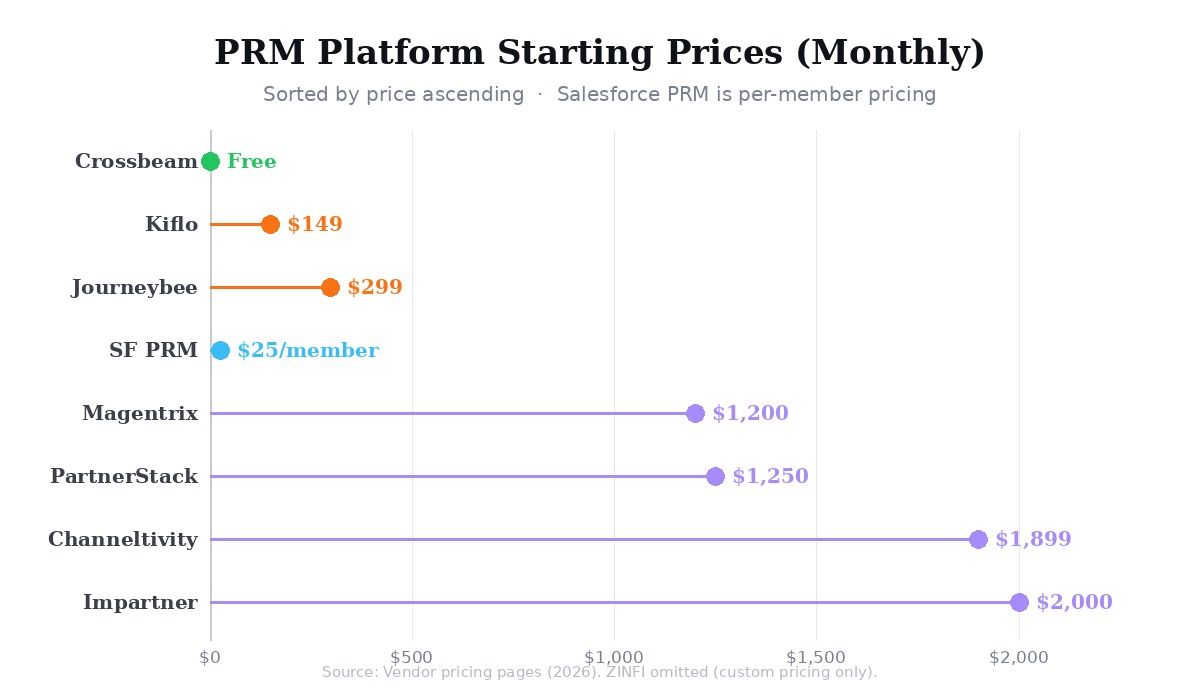
PRM pricing ranges from free (Crossbeam's basic tier) to $15,000+ per year (PartnerStack), with most mid-market options falling between $149 and $2,200 per month. Channelnomics forecasts global channel growth of 5-7% in 2026 (Channelnomics, 2026), so PRM investments are tracking alongside broader partner ecosystem expansion.
Budget matters, but so does fit. A $149/month tool that doesn't sync properly with your CRM will cost more in lost deals than a $2,000/month platform that keeps your pipeline clean.
From experience: Businesses typically underestimate PRM costs by 30-40% when they don't account for implementation time, CRM connector configuration, and partner training. The listed price is just the starting point.
PRM Market Growth: $1.51B to $4.29B by 2033
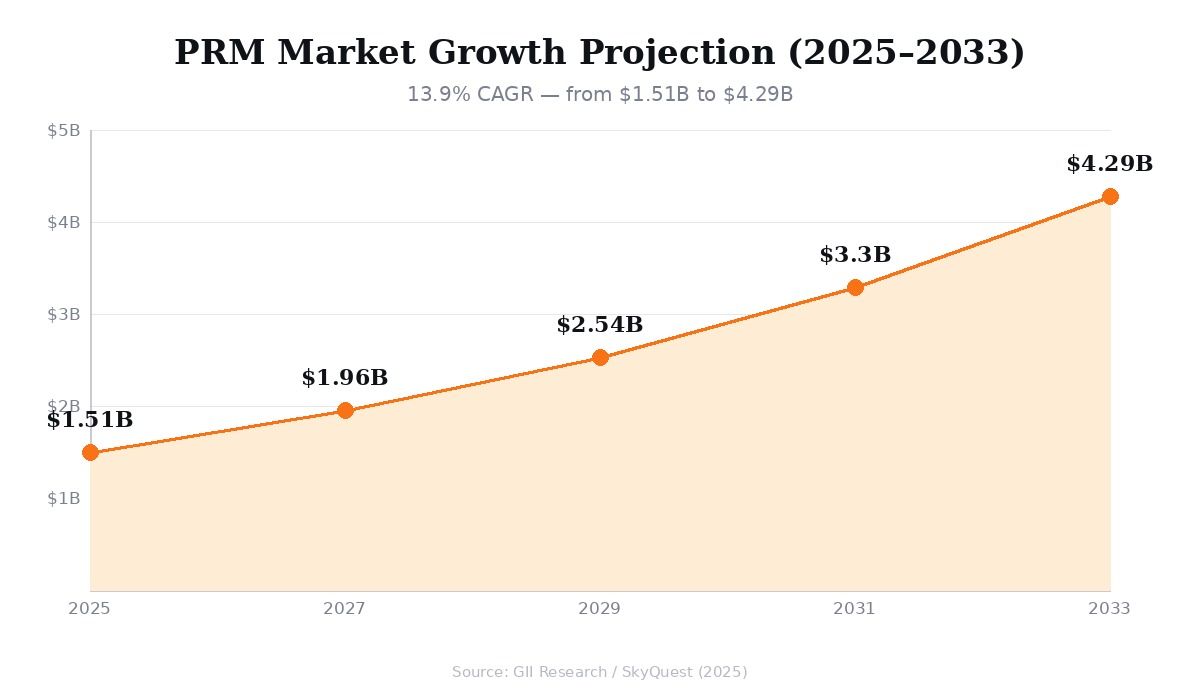
The PRM market is expanding rapidly — nearly tripling from $1.51 billion in 2025 to a projected $4.29 billion by 2033 (GII Research / SkyQuest, 2025). That 13.9% compound annual growth rate outpaces overall IT spending growth, which Gartner expects to surpass $6 trillion for the first time in 2026.
What's driving this? Partner ecosystems are projected to drive $80 trillion in annual revenue by 2030 (McKinsey via Continu, 2025). Companies that built strong partner programs aren't just growing incrementally — they're growing exponentially. And they need software to manage that complexity.
The Salesforce ecosystem alone is expected to create 9.3 million jobs and $1.6 trillion in new business revenues by 2026 (IDC/Salesforce, 2021). A significant portion of that value flows through partners, creating demand for PRM tools that connect directly to Salesforce.
From the field: Companies routinely go from zero to 50+ active partners in under 18 months once they deploy a PRM with proper CRM integration. Without that system, those same companies typically stall at 10-15 partners because manual overhead becomes unbearable.
What Should You Look for When Choosing a PRM Platform?
Sixty-nine percent of partner ecosystem leaders plan to increase PRM investments (Forrester, Q4 2025). Before you join them, make sure you're buying the right tool for your situation. Not every PRM fits every company.
CRM Integration Depth
Does the platform just push data to your CRM, or does it sync bidirectionally? Can it mirror your CRM's custom fields and objects? A shallow integration creates more work than it saves.
Partner Count and Pricing Model
Some platforms charge per partner, others charge flat monthly fees. If you plan to scale from 10 to 200 partners, make sure the pricing model won't punish that growth.
Implementation Timeline
Enterprise tools like Impartner and ZINFI may take weeks to deploy. Journeybee claims 24-48 hours. Kiflo and Crossbeam can be running the same day. Match deployment speed to your urgency.
Feature Fit
Do you need deal registration and lead distribution? Every platform on this list (except Crossbeam) includes those. Do you need MDF management, partner training, or a partner marketplace? The feature overlap narrows quickly.
Frequently Asked Questions
PRM (Partner Relationship Management) software manages your external partner relationships — deal registration, lead sharing, partner portals, and commission tracking. It connects to CRMs like Salesforce and HubSpot to sync deal data bidirectionally. Seventy-five percent of all global B2B transactions now flow through channel partners (Forrester, 2025), making PRM a core part of the go-to-market stack.
Kiflo is the strongest pick for small businesses, starting at $149/month for up to 5 partners with two-way Salesforce and HubSpot sync. Crossbeam's free tier also works for companies that need ecosystem intelligence more than full PRM features. Partner-involved deals are 53% more likely to close (Crossbeam via Continu, 2025), so even small teams benefit from a PRM.
Yes. Salesforce PRM (built on Experience Cloud) is a native option starting at $25/member/month. It offers the tightest CRM integration since there's nothing to sync — partner data is CRM data. The tradeoff is no HubSpot support, higher setup complexity, and missing features like automated payouts. Salesforce holds roughly 21% CRM market share (IDC via DemandSage, 2025).
CRM manages your direct customer relationships. PRM manages your partner relationships — the companies and individuals who sell on your behalf. They're complementary systems. The best PRM tools integrate with your CRM so partner-sourced deals flow into the same pipeline. Mature partner programs contribute up to 28% of total company revenue (Forrester, 2025).
Prices span a wide range: free (Crossbeam's basic tier) to $2,000+/month (Impartner). SMB tools like Kiflo start at $149/month, while mid-market options from Channeltivity and Magentrix run $1,200–$2,200/month. Enterprise platforms typically use quote-based pricing. Channelnomics forecasts 5-7% global channel growth in 2026 (Channelnomics, 2026), and PRM adoption is accelerating alongside it.
Ready to transform your Salesforce experience?
Start exploring the Salesforce Exchange today and discover apps that can take your CRM efficiency to the next level.
