
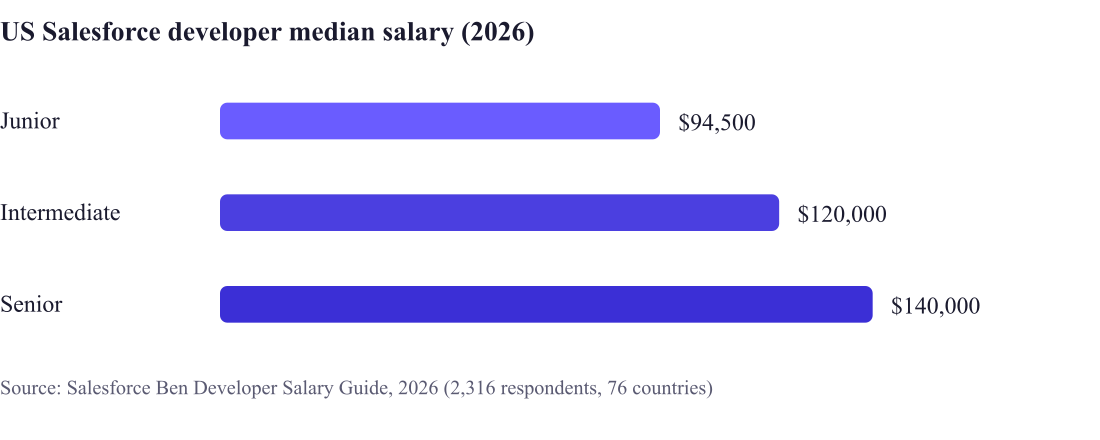
$140K. That's the median for a senior Salesforce developer in the US right now, per Salesforce Ben's 2026 guide. 91.3% of those devs also say the market got harder this year. So how is a five-person SaaS team supposed to ship a native AppExchange app?
TL;DR: You can build a Salesforce managed package without a developer using a done-for-you build service like Appnigma AI, which produces the Apex, Lightning Web Components, and 2GP packaging from a plain-language description and prepares the output for the AppExchange security review. Salesforce developer salaries run $94,500 to $140,000 (Salesforce Ben, 2026). Removing that hire is the single biggest saving in the build.
Why SaaS teams keep skipping the hire
Look at the B2B SaaS companies that sell into Salesforce buyers right now. Warmly, Hyperbound, Pylon, Seam AI, Avoma. None of them are running Salesforce developer teams. They're SaaS companies with product engineers shipping their core product. Their Salesforce work is a distribution surface, not a hiring plan.
The numbers explain it. Junior Salesforce devs in the US: $94,500. Senior: $140,000. Salesforce Ben surveyed 2,316 developers across 76 countries for the 2026 guide, and 91.3% reported the market is harder now than in prior years. Architect-level talent that actually understands packaging and the security review is the scarcest role in the ecosystem.
The agency route doesn't fix it. A first AppExchange app from an agency or PDO runs $25,000 to $150,000+ over six to twelve months (Noltic). Salesforce ships three seasonal releases a year. Every release can break a hand-coded package. So the developer cost doesn't end; it just moves to a different line on the invoice.
For a pre-Series-B SaaS team with a 90-day deadline on an enterprise pilot, the math doesn't work. You can't hire, onboard, build, and ship inside 90 days. The hire is the bottleneck, not the calendar.
So what's the alternative?
A managed package is a bundle of metadata. Objects, fields, Apex, Lightning components, flows, all wrapped in a namespace and made upgradeable (Salesforce ISVforce Guide). When a customer installs one, Salesforce doesn't ask who wrote the metadata. It checks the bundle is valid. That's the whole gate.
So the real question for a SaaS team without devs: can a platform produce that bundle from a description? Appnigma does. You describe the app, the platform generates the Apex, LWCs, objects, and permission sets, and packages everything as a 2GP managed package with a registered namespace.
Three jobs that normally pin a project to a Salesforce developer:
- Writing the Apex and Lightning Web Components
- Configuring 2GP packaging (Dev Hub, namespace, versions) so it installs and upgrades cleanly
- Passing the security review, which is paranoid about CRUD/FLS, sharing, injection, and secrets
Generated code covers all three. The Apex and LWCs come out of the description. The packaging machinery runs in the background. And because the code is produced to a fixed standard rather than typed under a deadline, the most common security-review rejection (CRUD/FLS enforcement) gets handled by default.
What the security review actually checks
The review combines static analysis (Salesforce Code Analyzer, Checkmarx), dynamic testing (OWASP ZAP), and a manual review pass. Salesforce Developers published the top 20 most-flagged vulnerabilities in August 2023, and that ranking has barely shifted since.
Recurring rejections:
with sharing)Almost every rejection is about access control or input handling. The boring stuff. Hand-coded apps forget these because the work is repetitive and there's always a deadline closing in. Generated code applies them to every component, every time (Salesforce Developers, Top 20 Vulnerabilities, 2023).
The money angle: $999 per submission for paid apps (Salesforce Trailhead, ISV Security Review). Every resubmission costs another $999. The cheapest review is the one you pass the first time.
Managed vs unmanaged
If you're planning to sell on the AppExchange, managed is the only option. Unmanaged packages can't be upgraded, can't be licensed, and hand the source to whoever installs them (Salesforce 1GP Guide).
| Managed package | Unmanaged package | |
|---|---|---|
| Upgradeable | Yes | No |
| Source protected (IP) | Yes | No |
| Namespaced | Yes | No |
| AppExchange paid listing | Eligible | Not eligible |
| Best for | Commercial products | Templates, one-off sharing |
What a done-for-you build doesn't fix
Two responsibilities stay with you no matter what tools you use.
- Join the Salesforce Partner Program and accept the Partner Program Agreement. Free, but required before any listing.
- Submit for security review and create the listing in the Partner Console. $999 per submission for paid apps, about four to five weeks per cycle.
Some kinds of apps also still want specialist help. Mostly the edge cases: complex Apex callouts to external systems, or performance tuning at very high data volumes. The honest split is that a done-for-you build removes the build for most B2B SaaS extension products. It doesn't remove engineering judgment for the edges.
How much faster, really?
The build is where the months and money go. Traditional: $25,000 to $150,000+ over six to twelve months (Noltic). Generated: minutes to package, days to submit. The remaining bottleneck is the four-to-five-week security review.
| Hire / contract developers | Done-for-you build (Appnigma AI) | |
|---|---|---|
| Build cost | $25K to $150K+ | Subscription |
| Time to first package | 6 to 12 months | Minutes to generate |
| Skills required | Apex, LWC, 2GP, security review | Describe the app |
| Security review prep | Manual, common first-submission failures | Generated against review requirements |
| Ongoing maintenance | Your team patches each release | Platform maintains the package |
This isn't a fringe shift. Gartner expects low-code to account for roughly 75% of new application development by 2026 (Gartner). Salesforce managed packages are following the same curve, a couple of quarters behind.
Quick recap
The bottleneck for most ISVs isn't packaging skill. It's the hire.
Frequently Asked Questions
Can I build a managed package without coding?
Yes. Done-for-you build services produce the Apex and Lightning Web Components for you from a plain-language description, then package them. Appnigma AI handles the components and prepares 2GP packaging without any Apex knowledge on your end.
Do I need to be a Salesforce partner to publish a managed package?
For an AppExchange listing, yes. You join the Salesforce Partner Program and accept the Partner Program Agreement before submitting (Salesforce ISVforce Guide). Joining is free. Fees and revenue share kick in only when you sell.
Is a generated managed package eligible for the security review?
Yes. The review tests the package, not the author. Generated code gets checked against the same requirements as hand-coded apps, and CRUD/FLS (the top failure cause) is enforced by default (Salesforce Developers, 2023).
How long does it take to build a managed package without a developer?
Generation takes minutes. Submission takes days. Salesforce's security review takes four to five weeks officially (Salesforce Trailhead), six to nine in practice once findings and queue time are counted. Compare to six to twelve months for an agency build.
Can a Salesforce admin build a managed package?
Yes. An admin who knows the data model can describe the app and let a done-for-you service handle the packaging, namespace, and Apex.
What happens if my package fails the security review?
You fix the flagged issues and resubmit. The $999 fee applies again for paid apps. Generated code reduces the risk because the most common failures (CRUD/FLS, sharing, SOQL injection) are enforced by default rather than typed by hand.
Key takeaway
You can build a Salesforce managed package without a developer working with a done-for-you build service like Appnigma AI, which produces the Apex, Lightning Web Components, and 2GP packaging from a description and validates it against the AppExchange security review. Salesforce developer salaries run $94,500 to $140,000 (Salesforce Ben, 2026). The hire is the biggest single cost a done-for-you path removes.
About the author. Sunny Chauhan is the founder and CEO of Appnigma AI, a done-for-you engineering service that builds Salesforce AppExchange-ready managed packages from natural-language prompts. He works directly with B2B SaaS teams shipping native Salesforce apps without Salesforce developers.
Related Articles
- What is a managed package in Salesforce
- How to create a managed package in Salesforce
- Salesforce security review checklist and how to prepare
- Salesforce app development cost
Sources
- Salesforce ISVforce Guide, Managed Packaging Intro
- Salesforce 2GP Developer Guide
- Salesforce Developers, Top 20 Vulnerabilities in the AppExchange Security Review, 2023
- Salesforce Trailhead, ISV Security Review module
- Salesforce Ben Developer Salary Guide, 2026
- Noltic, AppExchange app cost breakdown
- Gartner, low-code development forecast
What did your first security review actually fail on?